Rosette Strain Gauges
Ordering:
MFL Rosette strain gauges are supplied in multiple geometries, resistance values, and grid lengths. Bespoke designs can be engineered and delivered within a few weeks. You can send us a rough hand drawn sketch or other suppliers part numbers as a reference. Please let us know critical dimensions & resistance values in your enquiry.
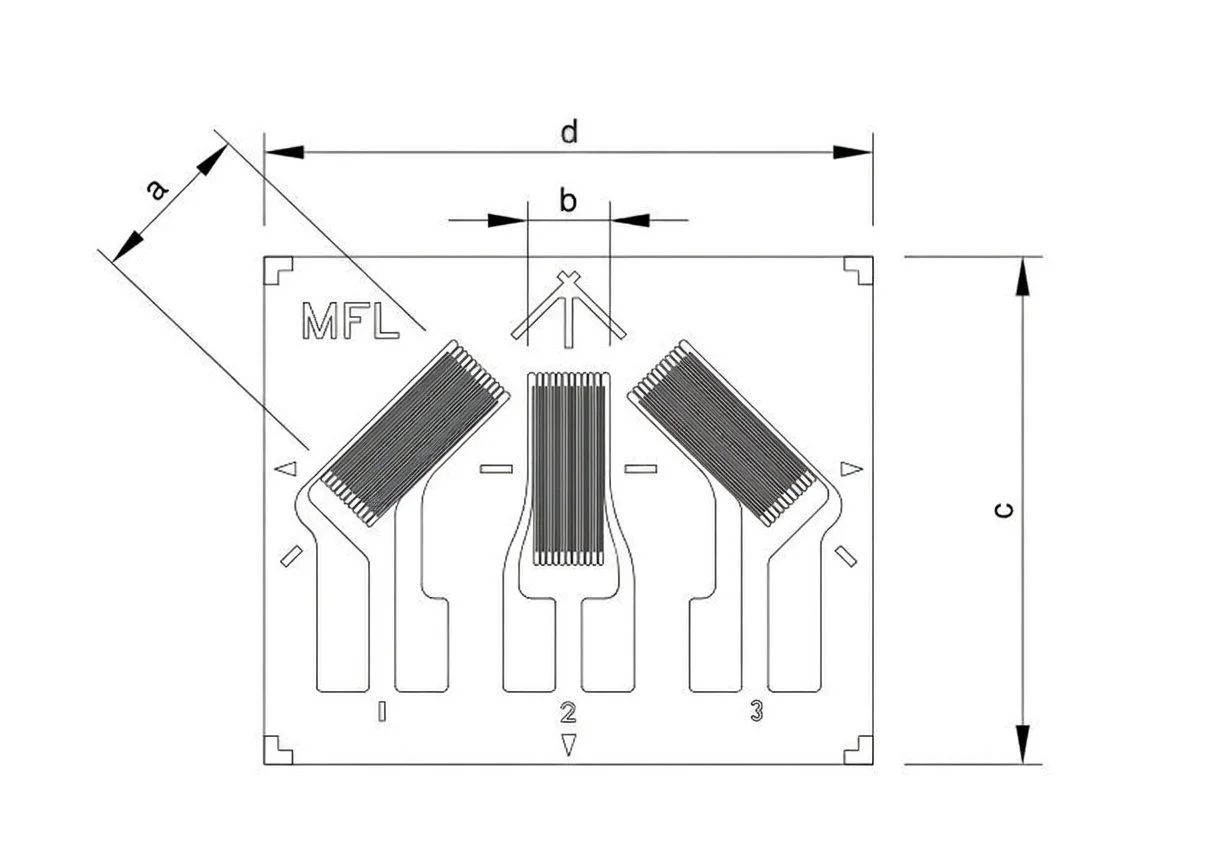
KEY:
(a) Grid length
(b) Grid width
(c) Matrix length (includes backing material)
(d) Matrix width (includes backing material
For Principal Strain and Multi-Axis Measurement
A rosette strain gauge (also called a strain gauge rosette) is a specialised foil strain gauge arrangement that measures strain in two or three directions at a single point. Rosettes are used when the principal strain direction is unknown or when the strain state is complex and cannot be captured with a single linear gauge. At MFL Strain Gauges (based in N.Ireland), our rosette gauges are designed to deliver accurate, repeatable data for principal strain, principal stress, and multi-axis strain analysis in research, validation, and industrial testing. Usual resistance requirements range between 120Ω - 2,000Ω (Ohms). MFL can custom design and manufacture to your exact requirements. We also have thousands of Strain Gauges in STOCK ready to ship in a range of sizes with NEXT DAY DELIVERY within UK & IRELAND.
What is a rosette strain gauge?
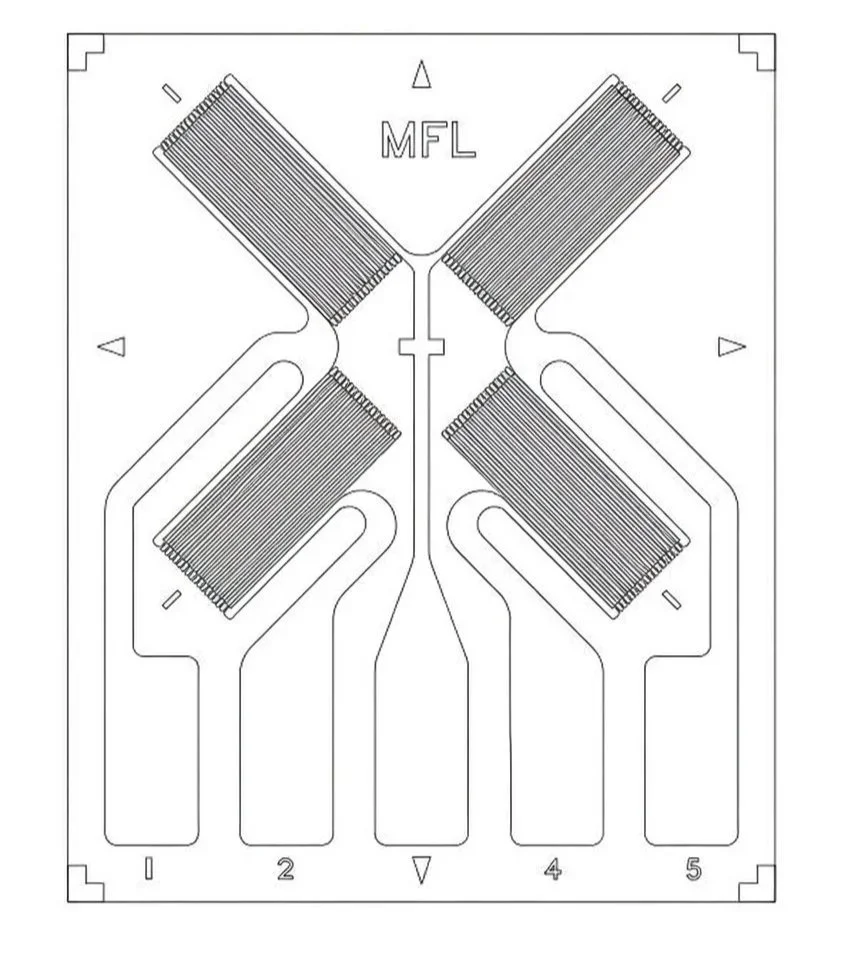
A rosette gauge combines multiple measuring grids on one carrier, each oriented at a specific angle. By recording strain in each direction, you can calculate principal strains and the orientation of those principal strains.
Multi direction measurement (2 or 3 grids)
2-element rosettes are used for certain applications and simplified analysis
3-element rosettes provide full in plane strain data at a point (commonly used for principal strain/stress calculation)
Common rosette angle patterns (45°, 60°, 90°)
Rosettes are typically supplied in standard patterns such as:
45° rosette
60° (delta) rosette
90° rectangular rosette
The right choice depends on geometry, expected strain field, and analysis preference.
Precision foil on polyimide backing
MFL rosette gauges use precision etched foil on a thin, robust polyimide carrier, keeping installation compact while maintaining excellent bonding and stability.
Where a single linear gauge might miss key information, a rosette provides the directional data needed to interpret real world strain in complex stress fields.
Typical applications for rosette strain gauges
1) Unknown principal strain direction
When you don’t know which way the structure is straining, a rosette captures it:
Complex brackets, castings, and machined parts
Mixed loading where tension, bending, and shear combine
Structures where load paths change with boundary conditions
2) Stress concentration and local feature analysis
Rosettes are commonly used around discontinuities where strain varies rapidly:
Holes, cut outs, notches, and keyways
Weld toes and heat affected zones
Fillets, corners, and geometric transitions
3) FEA (finite element analysis) correlation and validation
In R&D and design verification, rosettes help validate modelling assumptions:
Comparing predicted strain magnitude and direction to measured data
Confirming peak strain locations
Improving confidence in fatigue and safety assessments
4) Composite and anisotropic materials
In composites, strain direction and coupling effects can be non intuitive:
Laminates under combined loading
Bonded joints and interfaces
Prototype validation and material characterisation
5) Experimental mechanics, research, and failure investigation
Rosettes are a core tool in labs for:
Principal strain/stress mapping
Complex strain state investigation
Crack initiation and fatigue studies
Options and customisation with MFL Rosette Gauges
To match your geometry, instrumentation, and environment, MFL rosette strain gauges are available with:
A range of grid sizes to suit strain gradients and available mounting area
Multiple resistance options to suit your measurement system
Different lead styles for routing and connection preferences
Optional encapsulation for added protection in harsh environments or where handling robustness is required
If you share your material, surface curvature, expected strain range, and installation space, we can recommend a suitable rosette type and size.
Installation and measurement notes for best results
Alignment matters
Rosettes reference a “0°” direction. Accurate alignment to a known axis (e.g., principal geometry axis) improves interpretation and repeatability.
Surface prep and bonding quality
As with any foil strain gauge, correct surface preparation and adhesive selection are essential for stable, low-drift results.
Use rosette calculations for principal values
Rosette readings are typically converted using strain transformation to obtain principal strains (and principal stresses when material properties are known).
Why choose MFL Strain Gauges for rosette gauges?
As a N.Ireland-based foil strain gauge manufacturer, MFL designs rosette gauges to provide:
Accurate multi-axis strain measurement for principal strain/stress analysis
Stable, repeatable foil patterns for demanding test and industrial work
Robust polyimide backing, with encapsulation available where required
Configurable grid size, resistance, and lead style options to suit your setup
Rosette strain gauge FAQs
What does a rosette strain gauge measure?
A rosette measures strain in multiple directions at a single point, allowing calculation of principal strains and their orientation.
Which rosette type should I choose (45°, 60°, 90°)?
The best choice depends on geometry and analysis needs. If you tell us your component type, loading, and available space, we can recommend an appropriate rosette pattern.
Do you offer different sizes, resistance values, and lead styles?
Yes—MFL offers a range of grid sizes, resistance options, and lead styles, with encapsulation available when required.
Can rosettes be used near holes and welds?
Yes—rosettes are widely used in stress concentration areas, but selecting the right grid size and placement is important when strain gradients are high.