
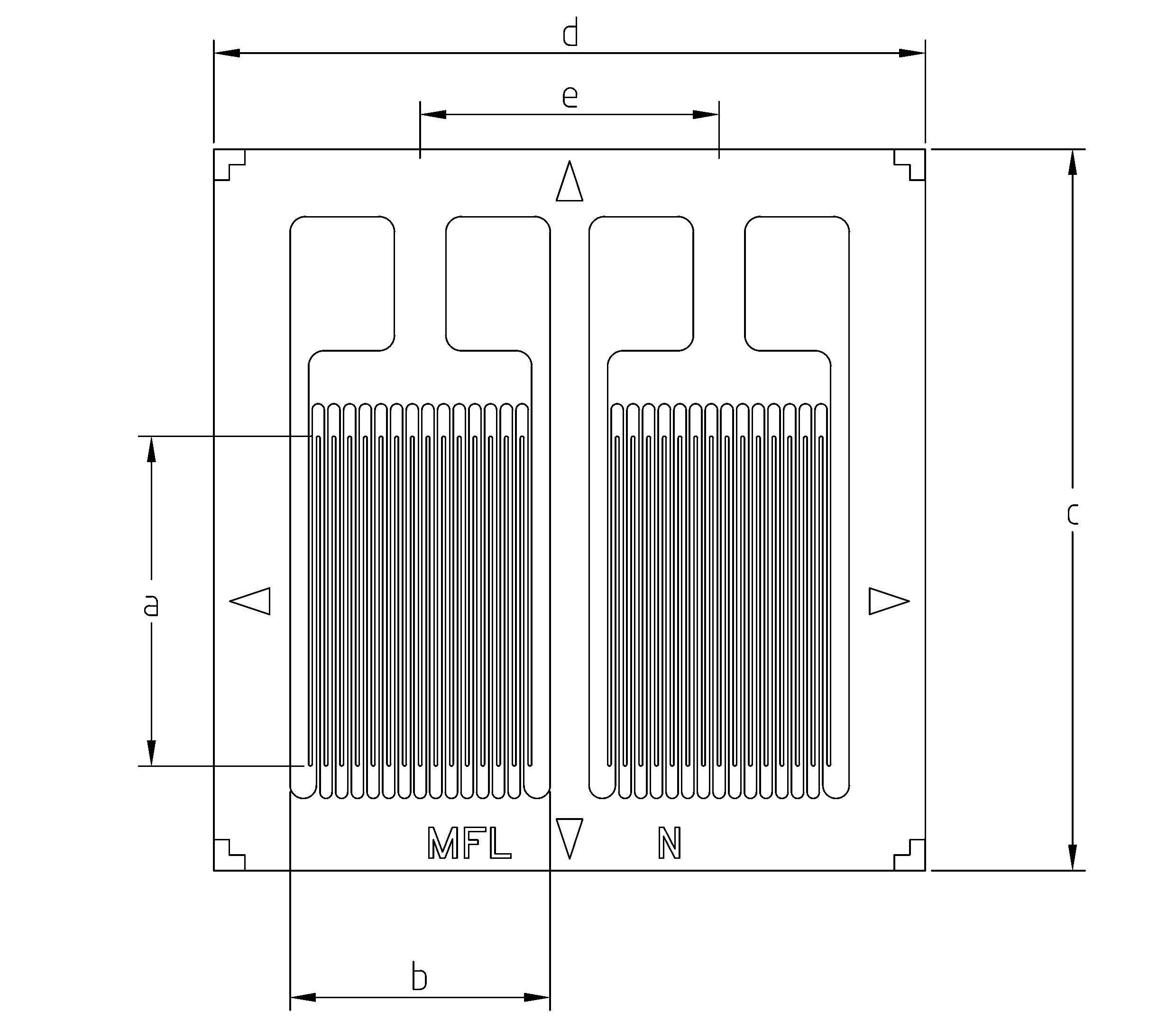
Ordering:
MFL dual strain gauges are supplied in multiple standard geometries, resistance values, and grid lengths. Bespoke designs can be engineered and delivered within a few weeks. You can send us a rough hand drawn sketch or other suppliers part numbers as a reference. Please let us know critical dimensions & resistance values in your enquiry.
KEY:
(a) Grid length
(b) Grid width
(c) Matrix length (includes backing material)
(d) Matrix width (includes backing material
(e) Longitudinal grid centerlines
Dual Strain Gauges
(Two Grids on One Carrier)
A dual strain gauge combines two separate measuring grids on a single carrier, giving you more information, improved signal quality, and flexible bridge configurations in the same footprint. At MFL Strain Gauges (based in N.Ireland), our dual gauges are designed for applications where you want to separate bending from axial strain, improve temperature compensation, increase bridge output, or add redundancy in demanding measurement tasks. Usual resistance requirements range between 120Ω - 2,000Ω (Ohms). MFL can custom design and manufacture to your exact requirements. We also have thousands of Strain Gauges in STOCK ready to ship in a range of sizes with NEXT DAY DELIVERY within UK & IRELAND.
What is a dual strain gauge?
A dual strain gauge contains two individual foil grids on one backing:
Two grids, one carrier
The two grids can be arranged side-by-side, back-to-back, or at specific angles depending on the application. Each grid has its own terminals, allowing the gauges to be wired independently or combined into bridge circuits.
Versatile bridge configurations
Dual gauges are commonly used to create:
Half bridges (one grid in tension, one in compression)
Temperature compensated setups (one active grid, one “dummy” grid)
Redundant or comparison measurements in a single location
Precision foil on polyimide backing
MFL dual strain gauges use precision etched foil on a thin, robust polyimide carrier for compact, repeatable installation and excellent stability.
Because both grids share the same backing and installation conditions, they track temperature and mechanical behaviour very closely often more consistently than two separate single gauges.
Typical applications for dual strain gauges
1) Separating bending strain from axial strain
Dual gauges are ideal on beams, shafts, and structural members where you need to distinguish bending from axial loads:
One grid placed on the tension side, one on the compression side
Wired as a half or full bridge to reduce pure axial effects and emphasise bending
Used in structural testing, machine frames, fixtures, and validation work
This produces a strong, clean bending signal with reduced sensitivity to secondary effects.
2) Temperature compensation using an active + dummy pair
In many installations, temperature change can mask true mechanical strain. A dual gauge allows you to:
Use one grid as the active measuring element
Use the second as a dummy gauge bonded to an unstressed region of the same material
Wire both into a half bridge so temperature effects largely cancel
Common in precision load cells, pressure sensors, and long-term monitoring.
3) Load cells and force transducers
Dual gauges are widely used in load and force measurement:
Less wiring and alignment complexity versus separate gauges
Matched grids for multi point measurement around a flexure
Compact half-bridge and full-bridge arrangements on small sensing elements
The result is higher sensitivity, improved balance, and reduced thermal drift.
4) Redundancy and comparison measurements
Where reliability is critical, dual gauges can add built-in redundancy:
Two grids measuring nominally the same strain
Outputs compared for fault detection and drift monitoring
Used in safety-critical structures, test rigs, and validation setups
If one grid deviates, it can indicate bonding, damage, or wiring issues.
5) Compact installations and tight spaces
Dual gauges pack more capability into a small footprint:
Instrument small components without multiple separate gauges
Reduce installation time and alignment complexity
Keep wiring tidier and more robust in harsh environments
Particularly useful for rotating machinery, compact fixtures, and miniature specimens.
Options and customisation with MFL Dual Gauges
To suit different geometries, bridge layouts, and environments, MFL dual strain gauges can be supplied with:
A range of grid sizes to match strain gradients and available mounting area
Multiple resistance options to suit your instrumentation and wiring requirements
Different lead styles for routing, space constraints, and connection preferences
Optional encapsulation when additional protection is required for handling or harsh environments
If you share your material, mounting space, loading type (bending/axial), and bridge preference, we can recommend a suitable dual gauge configuration.
Why choose MFL Strain Gauges for dual gauges?
As a N.Ireland based foil strain gauge manufacturer, MFL designs dual gauges to provide:
Matched, high precision grids for excellent bridge balance
Stable foil patterns with low hysteresis for demanding test and industrial use
Robust polyimide backing, with encapsulation available where required
Configurable grid sizes, resistance values, and lead styles to match your setup
Whether you’re building a high-accuracy load cell, separating bending from axial loads, or adding redundancy to a critical measurement point, MFL dual strain gauges provide a compact, dependable solution for getting the most from your strain data.
Dual strain gauge FAQs
What’s the advantage of a dual gauge over two single gauges?
Because both grids share the same carrier and installation conditions, they typically track temperature and mechanical behaviour more closely, improving bridge balance and repeatability.
Can dual gauges be used for temperature compensation?
Yes—one grid can act as the active element and the other as a dummy gauge in a half bridge to reduce temperature effects.
Do you offer different sizes, resistance values, and lead styles?
Yes—MFL offers multiple grid sizes, resistance options, and lead styles, with encapsulation available when required.
Need help choosing a dual gauge layout?
Contact MFL Strain Gauges with your component geometry, material, loading type, and bridge configuration and we’ll recommend a suitable option.